Systems Thinking in the Age of AI: Why Human Judgment Becomes More Valuable, Not Obsolete

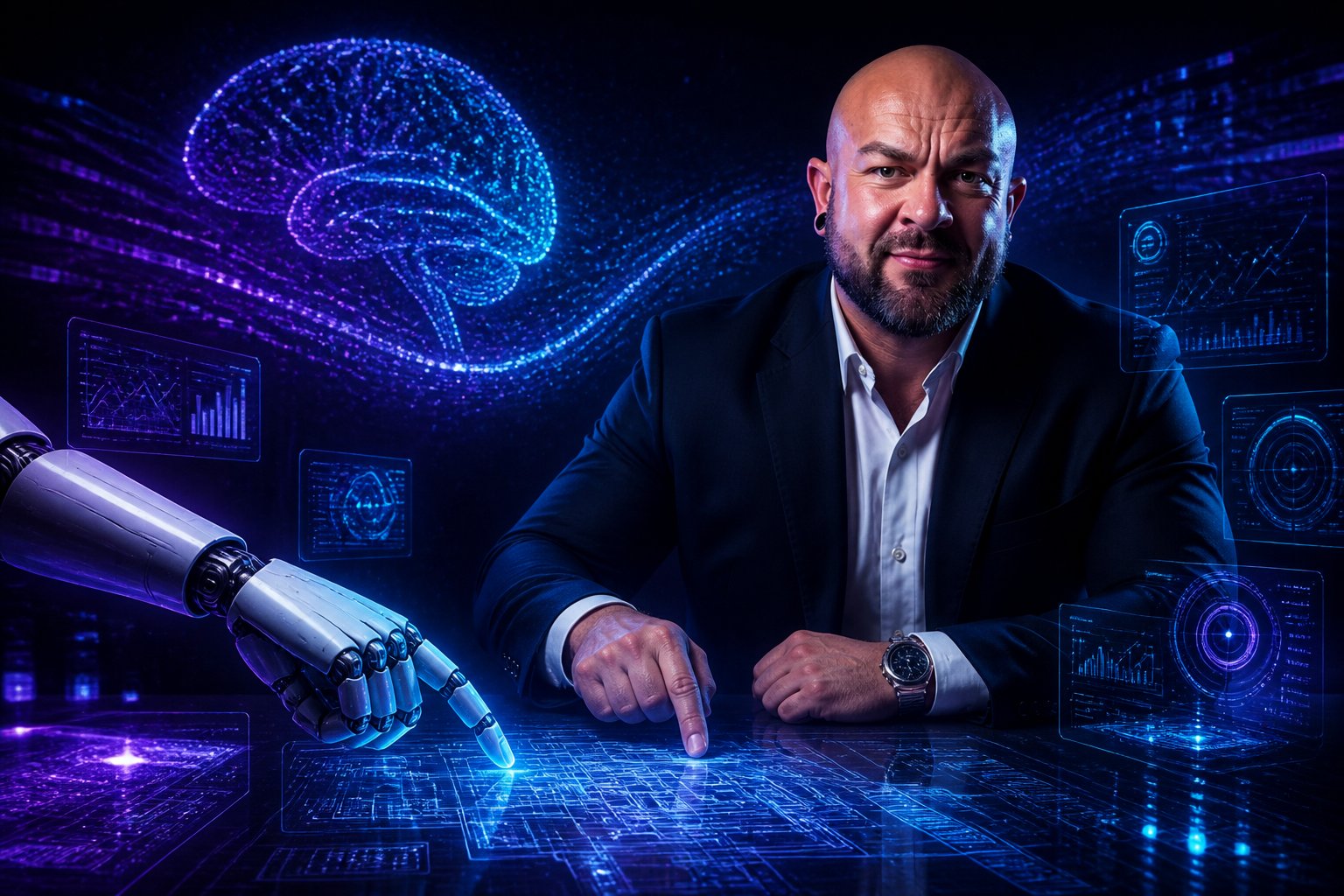
When AI Takes Over the Thinking – and Why That Makes Thinking Harder
It sounds paradoxical at first: the more capable AI systems become, the more important it is for humans to ask fundamental questions, define problems sharply, and critically evaluate results. IEEE Spectrum recently examined this connection under the term Systems Thinking – offering a thought-provoking perspective that extends well beyond the classic engineering domain. Companies in every industry face exactly the same questions: Which tasks do I hand over to AI? Which decisions must remain with humans? And who coordinates the interplay between them?
The New Division of Roles Between Humans and Machines
Modern projects – whether in product development, finance, or management consulting – increasingly follow a pattern that IEEE Spectrum describes using engineering as an example: a subject-matter expert defines the problem, AI tools search relevant sources, generate options, test them in simulations, and prepare results. Specialists then contribute their contextual knowledge – for questions that AI cannot assess: Is the result implementable in this specific environment? What regulatory or ethical frameworks apply? What impact does the solution have on people?
The actual decision remains with the human – and that is not a shortcoming, but by design. AI is not a substitute for judgment, but an amplifier of reach and speed. This distinction is fundamental and is still drawn too rarely in practice.
"The value of a human lies not in knowing everything – but in framing the problem correctly, asking the right questions, scrutinizing answers, and recognizing when a different expertise is needed."
Systems Thinking as a Core Competency – Beyond Engineering
What IEEE Spectrum describes as Systems Thinking is, at its core, a metacompetency: the understanding of how parts of a system interact, where dependencies exist, at which points errors can arise, and what conflicting objectives are present. In classic engineering, this means keeping electrical, mechanical, regulatory, and human factors in view simultaneously.
The same applies in a business context: an automated sales process interacts with the CRM system, influences how customers perceive the company, touches on data protection obligations, and has an impact on the work of the field sales team. Anyone who only examines technical feasibility without keeping the overall system in view risks producing a locally optimized, globally counterproductive outcome.
Dr. Maik Bunzel, founder and managing director of mabucon.eu, regularly emphasizes this point in consulting practice: many companies begin their AI initiatives with isolated automation projects – only to discover later that they have optimized processes that should actually have been questioned or redesigned from the ground up. Systems thinking does not start with the tool – it starts with the problem.
Where AI Excels – and Where It Fails
The strengths of AI systems are by now well documented: they process large volumes of data rapidly, recognize patterns, generate variants, and scale routine tasks without fatigue. It is precisely where speed, volume, and pattern recognition are required that Large Language Models, generative AI, and specialized ML models deliver their greatest value.
At the same time, IEEE Spectrum pinpoints with precision where AI runs into structural limits:
- AI can produce convincing answers even when its underlying assumptions are flawed.
- Generated code or a generated analysis may work in one test case and fail in another.
- AI can summarize research findings without assessing which evidence carries how much weight.
- AI can optimize for the wrong objective – namely the one specified in the prompt, not necessarily the one that was actually intended.
These characteristics do not make human expertise redundant; they shift its focus. Humans are no longer primarily executors of routine steps – they are coordinators, critical reviewers, and the final authority on contextual judgment.
Human-in-the-Loop: Not a Step Backward, but a Design Principle
In AI development, the established concept of Human-in-the-Loop refers to the deliberate integration of human review into automated processes. What has long been standard practice in safety-critical systems is now gaining significance in business processes as well. Not because AI is too unreliable to act, but because accountability, contextual knowledge, and value judgments remain genuinely human domains.
The decisive step for organizations is not technical in nature – it is organizational. The challenge is to define clear Delegation Boundaries: Which tasks are delegated entirely to AI agents? Which require human sign-off? Which must fundamentally remain with humans? These questions cannot be answered once and for all – they must be refined iteratively as understanding of the system matures.
Dr. Maik Bunzel, founder and managing director of mabucon.eu, describes this approach as one of the most critical success factors in deploying agent-based AI systems: organizations that treat automation purely as an efficiency project build quickly – and clean up the mess later. Organizations that factor in system boundaries, responsibilities, and escalation paths from the outset build more sustainably and with significantly less corrective effort down the line.
Specialization Remains Valuable – but Coordination Becomes the Bottleneck
One central argument from the IEEE Spectrum article deserves particular attention: AI does not replace the need for deep expertise in specific fields. It merely changes how readily people can access adjacent areas of knowledge. A software engineer working on a medical device can, with AI support, unlock biomedical specialist literature – without thereby becoming a medical professional. She can ask better questions before speaking with clinical staff.
The pattern transfers directly to business contexts: a marketing team using AI-powered data analysis does not gain the capabilities of a data science team – but it can communicate with such a team on a more informed basis. The quality of collaboration increases when all parties involved understand the language of the problem, even if they bring different depths of expertise to the table.
It follows that the bottleneck is rarely access to information. The bottleneck is the ability to coordinate across disciplines, critically evaluate results, and feed the right knowledge into the decision-making process at the right time.
Outlook: Systems Competence as a Strategic Competitive Advantage
For organizations, this analysis leads to a clear conclusion: building AI capacity alone is not a differentiating factor. Competitive advantages emerge where organizations develop the ability to intelligently combine human and machine – with clear role definitions, robust governance, and a structured approach to continuous problem definition.
This requires leaders and teams to develop a meta-competence that has long been recognized in academic literature but is still too rarely cultivated deliberately in practice: systems thinking. The ability not merely to optimize individual processes, but to understand and shape the interplay of processes, people, technologies, and external influences as a whole.
In the years ahead, AI will take on further tasks that are still considered genuinely human today. It is therefore all the more important to create the organizational and cultural foundations now, so that this transition happens in a controlled, responsible manner with a clear strategic purpose – rather than as a reaction to external pressure. Companies that actively shape this transformation will benefit from AI. Companies that experience it passively will be swept aside by it.