AI in the Cockpit: How Autonomous Systems Are Reinventing Air Travel – and What Risks Companies Need to Know

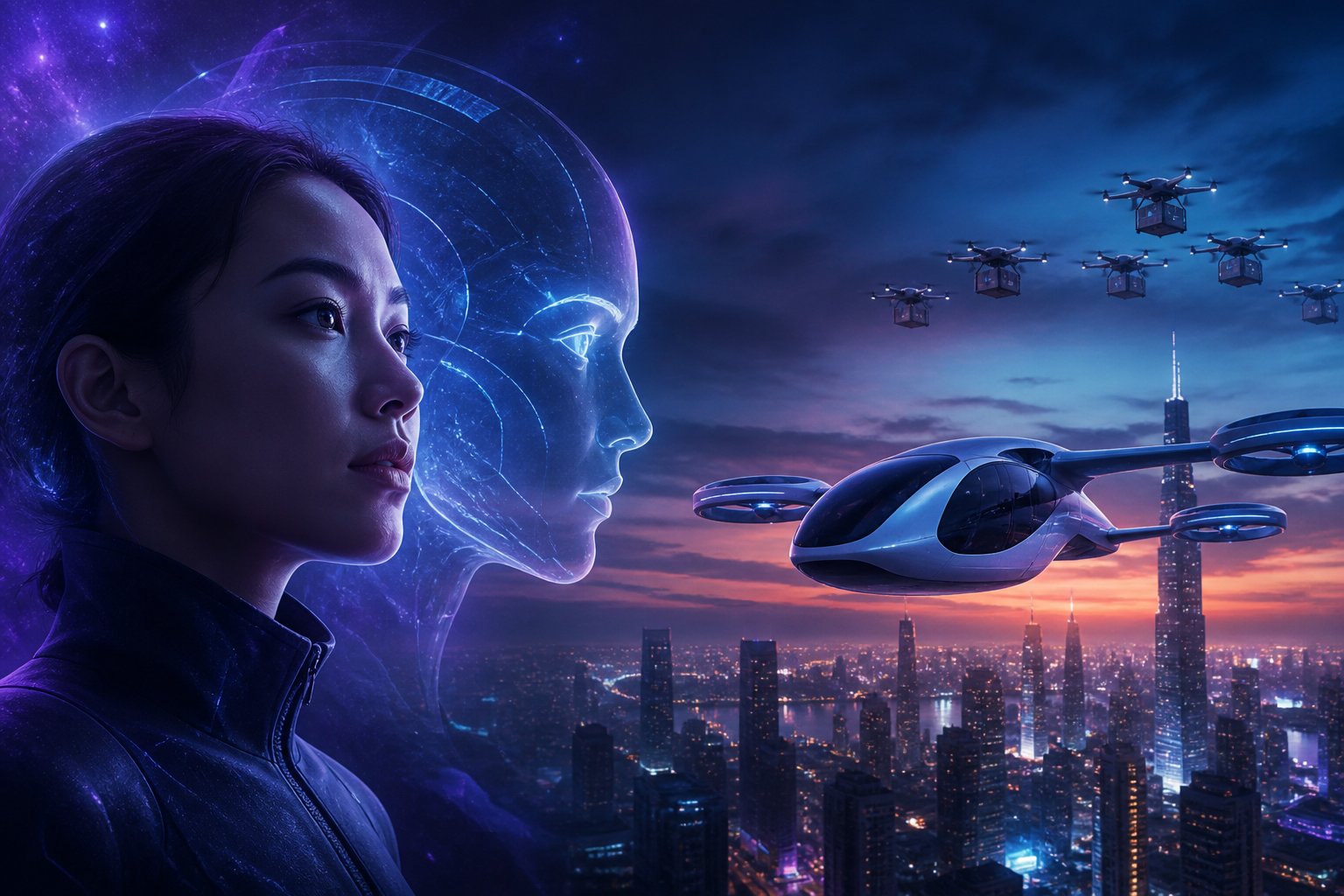
Aviation and AI: A Conservative Industry Yields
Few industries have so systematically resisted technological change as aviation. Decades-long certification processes, strict regulatory authorities, and the sheer gravity of potential consequences have ensured that innovation takes hold here far more slowly than elsewhere. Yet this equilibrium is beginning to shift – and at a pace that surprises even industry insiders. Artificial intelligence is penetrating the control towers, cockpits, and supply chains of global air travel, and the question is no longer whether, but how quickly and with what consequences.
5,000 Kilometres Without a Pilot: What Is Already Reality
Last September, a Cessna Caravan completed a fully autonomous flight from Northern California across the United States to the East Coast – roughly 5,000 kilometres, through busy controlled airspace, with evasive manoeuvres around severe weather. A human safety pilot was on board but did not need to intervene at any point. The company behind the project, Joby Aviation, describes the flight as a significant milestone on the path to commercial autonomy in the air.
In parallel, Joby tested the first intra-urban eVTOL flight in New York City this past April – from John F. Kennedy Airport to heliports in Manhattan. These electric vertical take-off and landing aircraft, or eVTOLs for short, are essentially oversized drones designed to carry a handful of passengers over short distances. Joby is not alone in this endeavour: by 2022, more than 600 different eVTOL models were in development worldwide. The vision is clear – affordable, autonomously operating air taxis as a complement to ground transportation.
AI in Air Traffic Control: Efficiency Gain or Underestimated Risk?
Beyond autonomous flight itself, AI is also making inroads into ground-based infrastructure. In the United States, the Department of Transportation recently introduced the "SMART" system – an AI-powered air traffic management tool designed to reduce delays and improve the efficiency of air travel. Yet barely had the system been unveiled when an incident occurred that abruptly shifted the debate: the FAA imposed a nationwide ground stop that threw the flight schedules of numerous airlines into chaos. Although official sources stressed there was no evidence of a cyberattack and no indication of SMART's involvement, the question lingered in the air – and could not initially be answered with any certainty.
"We're introducing all this new technology to improve the system – and it's going to be a disaster. This is literally a Pandora's box we're going to regret." – A recently retired FAA employee speaking to WIRED
This statement exemplifies a deep skepticism that is growing within the industry. The question of whether AI systems are sufficiently robust and transparent in safety-critical infrastructure is not an academic one – it is highly practical and time-sensitive. Dr. Maik Bunzel, founder and CEO of mabucon.eu, regularly emphasizes in this context that the reliability of an AI system must not be measured by its performance under ideal conditions, but by its behavior under stress, with unexpected inputs, and in edge cases – precisely those scenarios that can be a matter of life and death in aviation.
Drone Deliveries: From Pilot Project to Mass Infrastructure
While eVTOLs are still awaiting commercial certification, drone delivery has already entered the scaling phase. Amazon plans to expand its delivery service to 500 locations across the United States. Walmart intends to offer drone deliveries from 270 stores by the end of 2027. And this is just the beginning: industry insiders suggest that within five to ten years, hundreds of thousands of drones could be deployed on a near-ubiquitous basis – an infrastructure that would literally redefine the skies above our cities.
The technical foundations for this were partly laid back in the 2000s. The US NextGen program of 2007 mandated that aircraft be equipped with ADS-B – a radio system that continuously transmits the position and heading of an aircraft. This infrastructure is a prerequisite for autonomous drones to operate safely in shared airspace with manned aircraft.
Regulation Between Silicon Valley Speed and Aviation Culture
The conflict emerging in the AI aviation debate is fundamentally a cultural one: Silicon Valley thinks in iteration cycles of weeks, while aviation certification thinks in years. The European aviation authority EASA recently put plans by Airbus and Dassault to operate commercial airliners with only one pilot on hold – under massive pressure from pilot unions. The European Cockpit Association warned that such an approach would remove an independent safety professional from the cockpit and give operators greater influence over safety-critical decisions.
This point deserves particular attention: the issue is not solely one of technical reliability, but of institutional checks and balances. Who or what makes the final call in an emergency – and bears responsibility? These are not purely philosophical questions; they have direct regulatory and liability implications.
- Autonomous flight has already been demonstrated technically – commercial certification is the next step.
- eVTOL air taxis are on the verge of carrying paying passengers, initially still with pilots on board.
- Drone deliveries are scaling massively – regulatory frameworks are lagging behind practice.
- AI-assisted air traffic control is already in use, but the question of trust has yet to be conclusively answered.
- Liability and responsibility for autonomous systems remain largely unresolved in legal terms.
What Businesses Need to Understand Now
Developments in aviation are not a niche topic – they are a harbinger of what is coming in virtually every industry where AI systems are expected to take on operational responsibility. Logistics providers, insurers, manufacturers, and infrastructure operators will, in the near future, have to engage with autonomous AI agents that do not merely analyze data, but act independently.
Dr. Maik Bunzel, founder and managing director of mabucon.eu, notes in his consulting practice that companies frequently make two mistakes: they overestimate the short-term maturity of autonomous AI systems while simultaneously underestimating the long-term transformational pressure this technology generates. The right response, he argues, is neither blind trust nor reflexive rejection, but a structured approach to risk assessment, governance, and incremental integration.
In practical terms, this means the following for companies that are deploying or planning AI-powered automation:
- System transparency: AI agents that act autonomously must leave traceable decision paths – especially in safety-critical or regulated contexts.
- Define Human-in-the-Loop: Where must a human make the final decision without exception? Drawing this boundary is a strategic matter, not merely a technical one.
- Fail-safe design: What happens when the system fails? Robust automation requires that fallback levels are defined and tested.
- Early regulatory monitoring: The rules governing autonomous systems will change significantly in the years ahead – those who ignore this risk costly retrofitting.
Outlook: The Sky as a Test Lab for the AI Society
Aviation is, in a sense, an extreme case: nowhere are the requirements for reliability, safety, and regulatory compliance higher. The fact that AI is making inroads there too – and with increasing speed – says a great deal about how deep the transformation driven by autonomous systems will go. The nationwide ground stop in the United States, the abandoned single-pilot plans in Europe, and the drone ambitions of major retailers together tell a single story: we are in the middle of a negotiation process over how much autonomy we are willing to grant AI systems in critical infrastructure.
This process will not unfold smoothly. It will involve setbacks, regulatory course corrections, and technical failures that trigger public debate. For companies, this is no reason for passivity – quite the contrary. Those who lay the right foundations now, develop the necessary governance structures, and prepare their organizations to work with autonomous systems will be better positioned in the long run than those who equate standing still with staying safe. The sky will change – the question is who helps shape the rules of the game.