AI in Space: When Autonomous Agents Control Rovers and Manage Space Stations

Space as a Test Laboratory for Autonomous AI Systems
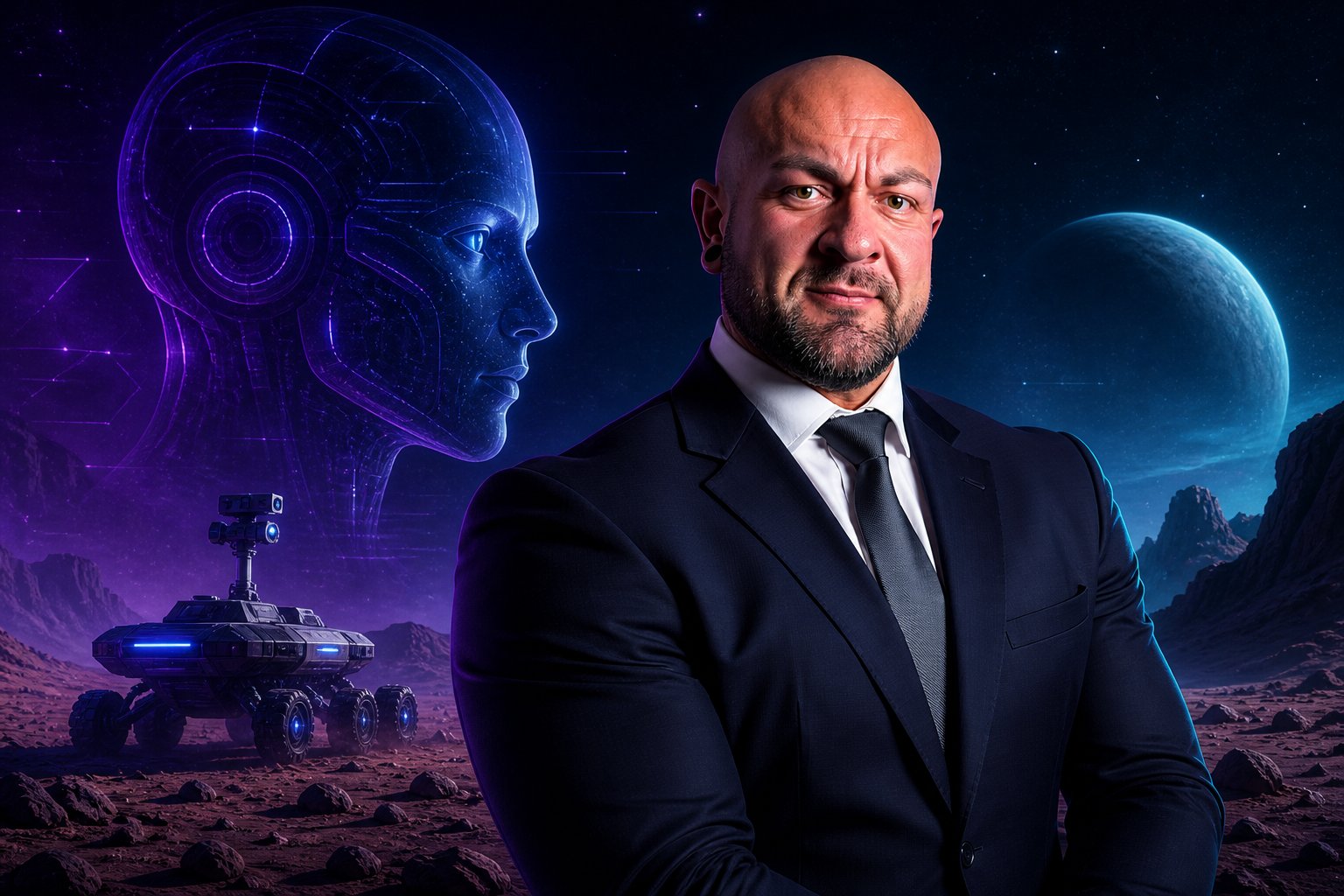
What long sounded like science fiction is now taking concrete shape: generative AI systems are increasingly taking on planning and decision-making tasks in space – a field traditionally known for its extreme risk aversion. NASA's Jet Propulsion Laboratory used Anthropic's Claude models to plan driving routes for the Perseverance rover on Mars. IBM and NASA installed a compressed AI model on the International Space Station (ISS) to detect floods and cloud formations from Earth orbit. And astronauts tested Large Language Models (LLMs) for answering maintenance questions directly in orbit.
These developments mark more than technical milestones in aerospace. They are a symptom of a profound paradigm shift: systems that previously had to operate deterministically – that is, in a fully predictable manner – are increasingly opening up to non-deterministic AI architectures. This has far-reaching implications that extend well beyond space.
The Determinism Dilemma: Why Engineers Feared Autonomy
For decades, an ironclad principle held sway in aerospace engineering: a system must always deliver identical results under identical input conditions. Robert Ambrose, former head of NASA's Software, Robotics and Simulation Division, puts it plainly: if the same scenario is reached via different paths, an autonomous system may respond differently – and that is precisely what engineers traditionally hated.
"Autonomy often has no deterministic outcome. How you get into a particular situation changes the behavior. And engineers hated that." – Robert Ambrose, former NASA Division Director
Yet as mission complexity grows and distances from Earth increase, this insistence on complete control becomes a limiting factor. A hypothetical scenario illustrates the problem: on a mission to Jupiter's moon Europa, a water geyser could erupt so suddenly from the surface that engineers on Earth would have no time to transmit control commands. Signal travel time alone makes real-time intervention impossible. Without genuine autonomy, such a mission would simply be unworkable.
Ambrose himself recounts how NASA ultimately solved this complexity problem with the very same means that caused it: by automating the tests themselves. "We fought the challenges of autonomy with autonomy." An approach that is becoming increasingly relevant for enterprise applications as well.
Physics as a Learning Problem: What Space Robotics Teaches Us About AI Training
The startup Icarus Robotics is developing a robotic workforce system for space. Their free-floating system "Joy" is initially designed to transport cargo bags between ISS modules – under human remote control, with the goal of using that training data for later fully autonomous operations. In doing so, the developers encounter a fundamental problem: every AI model trained on Earth has gravity encoded into it as an implicit baseline assumption.
When a robot on Earth learns that a pushed object falls, this intuition for physics transfers into its neural weights. In orbit, where the same object simply keeps floating, even the most powerful models fail immediately. This is no edge case – it is a fundamental warning signal for all AI implementations: training data and deployment environment must be systematically aligned. Missing domain data, as in the case of microgravity robotics, forces companies to build their own datasets rather than relying on existing foundation models.
Risk Management of Autonomous Systems: The Real Challenge
Ufuk Topcu, engineering professor at the University of Texas at Austin and director of the Center for Autonomy, brings an important perspective: it is almost paradoxical that space systems – precisely those applications where human intervention is most difficult – have historically exhibited the least autonomy. The real challenge is not teaching systems to act independently. It is about making the risks of that freedom manageable.
Icarus Robotics' cofounder Jamie Palmer describes the planned rollout aptly: "What the rollout will probably look like is something that starts much closer to partial autonomy – with human oversight at all times." This philosophy – Human-in-the-Loop as an intermediate stage, not an end state – is also the gold standard for enterprise applications in the current phase of AI development.
Dr. Maik Bunzel, founder and CEO of mabucon.eu, observes this dynamic in business automation projects as well: "We see exactly the same curve in companies that the space industry is currently going through. It always starts with the desire for complete control and predictability. But beyond a certain level of complexity, it is more efficient to give systems a defined decision-making latitude and focus human supervision on exceptions – rather than managing every individual step."
What Companies Can Learn from Space AI
The experiments of the space industry are no lofty niche project. They distill and accelerate insights that are directly transferable to enterprise automation. The following key principles are emerging:
- Autonomy is not a binary switch: The transition from complete human control to true machine autonomy runs through intermediate stages. Partial autonomy with defined escalation paths is often the most pragmatically sensible starting point.
- Domain-specific training data is crucial: Generic base models – no matter how powerful – fail in specialized environments without domain-specific Fine-Tuning or Retrieval-Augmented Generation (RAG). This applies to microgravity just as much as to industry-specific business processes.
- Testing does not scale linearly: The more autonomous a system, the exponentially more complex the test coverage becomes. NASA solved this problem through automated testing – an approach that is becoming increasingly indispensable in enterprise AI as well.
- Latency enforces autonomy: Wherever response times are shorter than human decision cycles – whether in space or in real-time business processes – AI autonomy is not an option but a necessity.
- Managing non-determinism, not eliminating it: The fear of non-deterministic systems is understandable, but often exaggerated. With robust Guardrails, defined acceptance criteria and continuous monitoring, non-determinism can be made manageable.
Building trust as a critical success factor
In both space exploration and enterprise applications, the same principle holds: the greatest obstacle to AI autonomy is not the technology itself, but the institutional trust in its reliability. NASA engineers had to accumulate years of experience with Orion and Robonaut 2 before more autonomous approaches were seriously discussed. The adoption process in companies follows a similar path: initial pilot projects with a clearly limited scope and measurable results build the trust that is necessary for broader rollouts.
Dr. Maik Bunzel, founder and managing director of mabucon.eu, emphasizes the importance of transparency in this context: "AI agents that document their decision paths in a traceable manner create precisely the trust that organizations need in order to gradually delegate more responsibility. Explainability is not a nice-to-have here, but a fundamental prerequisite for sustainable automation."
Outlook: Complexity as a driver, not a brake
The space industry faces an interesting paradox: precisely because missions are becoming more complex, more distant and more numerous, they can increasingly ill afford complete human control. Autonomous AI systems are not the risk here – they are the answer to the risk of under-complexity inherent in previous approaches.
The same logic applies to businesses. Business processes are becoming more complex, data volumes are growing, and decision cycles are shortening. Organizations that begin today to gradually equip their AI agents with greater decision-making authority – supported by robust monitoring and escalation structures – will tomorrow hold a structural advantage over those that still insist on complete manual control.
Space exploration shows: the moment when systems must decide autonomously arrives sooner than expected. The question is not whether, but how well prepared you are for it.