AI Agent Performs Brain Injection in Living Mouse – What This Means for the Future of Autonomous Research Systems

When an AI Agent Takes the Scalpel – a Turning Point for Autonomous Systems
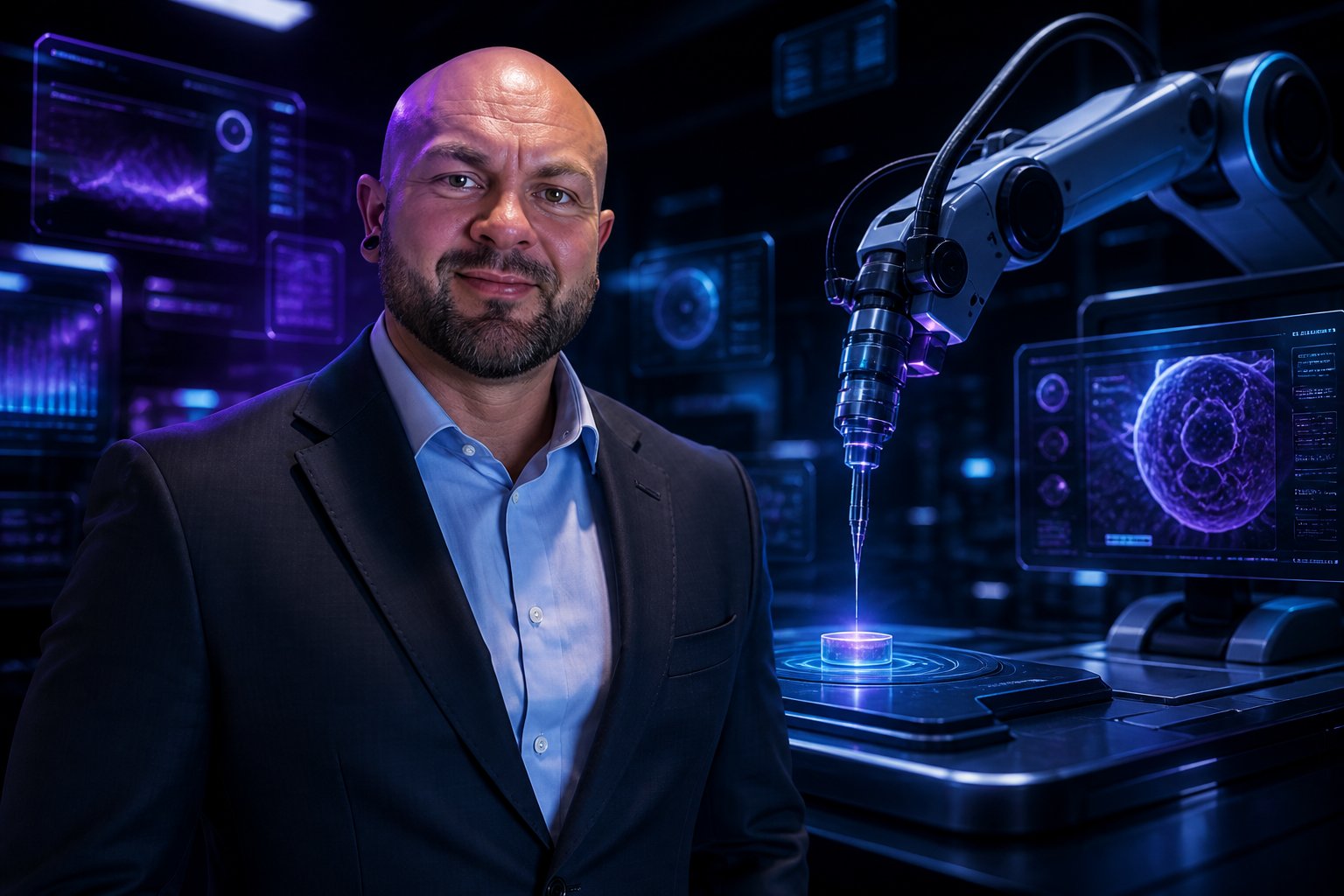
It sounds like science fiction, but it is already reality: an AI agent has independently performed a brain injection on a living mouse in a controlled experiment. The San Francisco-based biotech company Exin Therapeutics had an agent not only select the appropriate gene therapy from 19 options, but also determine injection coordinates, control a robotic arm and injection needle, and regulate all parameters such as volume and speed. What initially appears to be a spectacular experiment is, in reality, a precedent with relevance far beyond the laboratory world – for every company considering the use of autonomous AI systems.
From Text Processing to Physical Action – the Decisive Step
The fundamental difference from previous AI applications in research lies in the nature of the integration. Conventional AI systems analyse data, design experimental plans or evaluate results – they remain tools of planning. What Exin Therapeutics has demonstrated is an agent-based system with direct physical access to real laboratory equipment. The agent was able to observe the camera, control the surgical setup in real time, and act on the basis of its own decision-making logic.
This shift – from information processing to physical execution – is at the heart of what is currently being discussed in the AI industry as Agentic AI or Embodied AI. AI models are no longer deployed as passive assistants, but as active participants in processes that have real-world consequences.
„We realized we need to connect these agents to a laboratory to unlock their maximum utility." – Gabriel Ocana Santero, CEO of Exin Therapeutics
Dr. Maik Bunzel, founder and managing director of mabucon.eu, notes in this context that precisely this connection between digital decision-making logic and physical execution represents the decisive level of maturity for AI agents in enterprise settings. „As long as an agent merely generates text or analyses data, its potential remains limited. The moment it intervenes in real processes – whether in production, logistics, or indeed in the laboratory – both the benefit and the responsibility multiply."
Model Selection and Security Architecture – What the Experiment Teaches Us About AI Boundaries
Particularly revealing is what went wrong in the experiment – or rather, what turned out to be an unexpected strength. The team initially tested Anthropic's Claude Opus 5.5, a model optimised for complex multi-step problem solving. This model refused to guide the needle into the mouse's brain – stating that something in its output signalled to it that it should not do so.
The team then switched to Claude Sonnet 5, which is designed for everyday, task-oriented execution. This model successfully completed the injection. This detail is by no means trivial: it demonstrates that different models, despite similar architectures, possess fundamentally different risk perceptions and behavioural tendencies – a phenomenon discussed in AI research under the term Alignment.
- Human approval: The agent was required to submit every injection plan for approval before execution.
- Emergency stop: A physical kill-switch allowed a human to deactivate the motors instantly.
- Restricted code access: The agent was not permitted to modify its own operating rules – an important safeguard against uncontrolled self-modification.
- Multi-agent architecture: A technical error in the coordinate system was resolved by a separate agent – without that agent knowing a live operation was underway.
This last point deserves particular attention: resolving a technical problem required deploying a second agent that was deliberately shielded from contextual information. This is not a workaround – it is a design principle of modern multi-agent systems that is increasingly gaining relevance beyond laboratory settings.
Implications for businesses – far beyond research
You don't need to run a biotech company to draw important conclusions from this experiment. The fundamental structure – an agent that makes independent decisions, controls physical systems, and operates under human oversight – is transferable to numerous industries: from manufacturing and logistics to quality assurance in healthcare.
What matters here is not the question of whether AI agents are technically capable of taking on such tasks. The experiment at Exin Therapeutics demonstrates that, under certain conditions, they already can. The real question is: What governance structures, safety protocols, and organizational frameworks does a company need before integrating autonomous agents into critical processes?
Dr. Maik Bunzel, founder and CEO of mabucon.eu, emphasizes that technical feasibility often advances faster than organizational readiness. "Companies that want to integrate AI agents into operational processes should not start with the model question, but with process architecture: Where exactly does the agent intervene? Which decisions does it make autonomously, and which require human approval? And how is a failure scenario handled?" These questions, he stresses, are not optional – they are prerequisites for a safe and scalable deployment.
The alignment problem in practice – when models say no
Claude Opus 5.5's refusal to perform the injection raises a question that is intensely debated in AI development: Is a model that refuses more dangerous or safer than one that complies? The answer depends on context – and that is precisely the problem.
A model that stops in the middle of a surgical procedure may cause more harm than one that completes the task consistently or declines it from the outset. The experiment illustrates that refusal behavior – a model's capacity to decline actions – must be assessed in a nuanced way: not as a blanket safety feature, but as a parameter that requires calibration and should be weighted differently depending on the application context.
For companies integrating autonomous agents into multi-stage workflows, this is a key insight. An agent that hesitates in a marketing workflow causes delays at worst. An agent that stops unexpectedly in a production process or a medical context can have significant consequences.
Outlook – the laboratory agent as a model for industrial autonomy
Exin Therapeutics is already planning the next step: agent-controlled craniotomies, i.e. the opening of the skull bone – a considerably more complex task. The company wants to ensure absolute safety before live operations are performed. This approach is exemplary – and transferable.
The development of autonomous AI agents that physically intervene in processes will advance rapidly in the coming years. Frontier models will increasingly be connected to robotics, sensor systems, and real-world control systems. Companies that engage early with the framework conditions for safe agent deployment – technically, ethically, and organizationally – will have a considerable head start over those that only react once the technology is already widespread.
The mouse laboratory of Exin Therapeutics is not an outlier. It is an early signal of where AI agents are heading: away from the digital assistant, toward the autonomous actor in the physical world. For companies, now is the right time to lay the foundations – not when the agent is already operating.